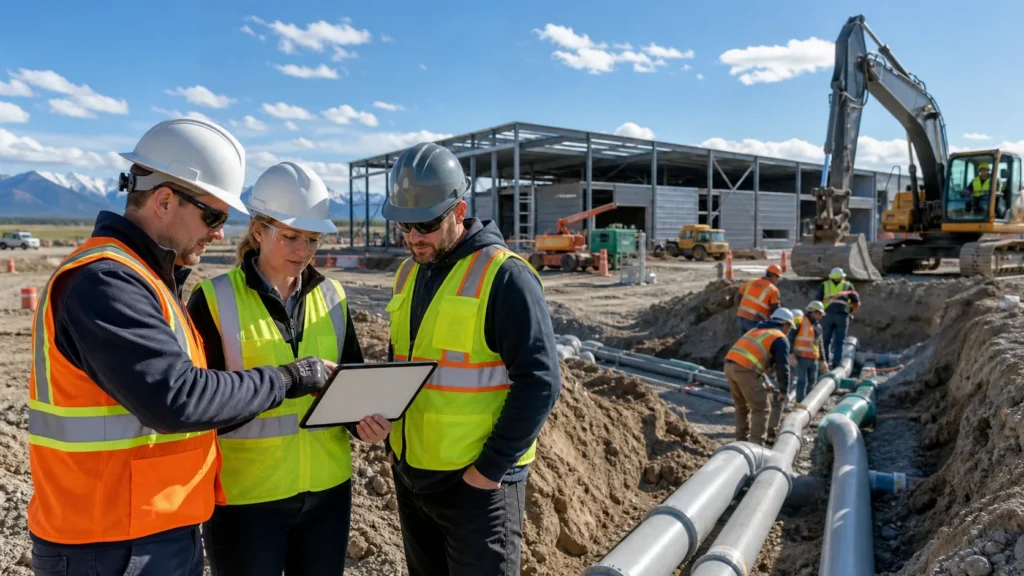
Utility capacity belongs at the start of an industrial land decision, not near the end of construction. From our perspective as long-term investors, power, gas, water, wastewater, stormwater, telecommunications and transportation access can all shape what a site can become, how quickly it can be developed and how broadly it will appeal to future occupiers.
In Calgary, a parcel may look well serviced from the road while still lacking the confirmed capacity needed for a warehouse, logistics campus or high-demand industrial operation. Treating capacity as a land-value question from day one is advisable.
Utility Capacity Can Protect Industrial Land Value
Industrial growth in Calgary is closely linked to distribution networks, trade corridors, rail connections, airport cargo activity, manufacturing and energy services. These systems support the movement of goods across Alberta and Western Canada, but access to a corridor is only part of the equation. A facility also needs the services required to operate at its intended scale.
Before committing to a site, owners and investors should ask a practical question: can this property support the building, equipment and future expansion we have in mind? The answer may involve a wide group of specialists, including municipalities, utility providers, civil engineers, electrical consultants, planners, lawyers, lenders and contractors.
Utility capacity can influence:
- The size and type of building a site can support
- The timing of occupancy and tenant improvements
- The intensity of manufacturing, storage or fleet operations
- The ability to add future phases or higher-demand users
- The long-term flexibility and marketability of the land
A site with scalable servicing may support more possibilities over time. On the other hand, limits on power, water, sanitary service or road access can narrow the pool of potential users, even when the land is in a strong industrial location.
Industrial Construction Services in Calgary Begin with Capacity
For industrial construction services in Calgary, utility due diligence should begin before a land acquisition becomes unconditional and before the final building program is locked in. Early review gives the project team time to understand nearby substations, electrical feeders, gas mains, water and sanitary connections, telecom routes, easements, rights-of-way and potential off-site improvement obligations.
Visible infrastructure is not the same as available capacity. A power line near the property does not automatically mean it can support a high-load tenant. The same is true for a nearby water main or gas service. Current, written confirmation from the relevant utility owner or authority is generally essential, which may include ENMAX Power, ATCO Gas, The City of Calgary or another provider based on the service and location.
Larger projects also need clarity around responsibility. Extension work, transformers, line relocations, road modifications and new utility easements can affect the development plan. Our approach is to establish who will build the infrastructure, who will own it, how service timing will be coordinated and whether capacity must be reserved through an agreement. Legacy reports and prior site plans can be useful background, but they should never replace current utility requirements.
Size Demand Around the Operating Model
Utility planning changes with the asset. A dry warehouse may have moderate base electrical needs, yet still require significant heating, lighting, dock equipment and battery charging. A temperature-controlled distribution centre, food processor, advanced manufacturer or fleet depot may have much higher requirements for electricity, natural gas, water, wastewater or fire flow.
Accordingly, project teams should estimate more than the opening-day load. The servicing plan should consider expected use at occupancy, peak demand and the likely needs of future expansion bays, automation, refrigeration, electric forklifts, fleet charging, rooftop solar, battery storage or tenant improvements.
A sound review often considers:
- Initial operating demand at occupancy
- Peak electrical, gas, water and wastewater requirements
- Future tenant or expansion scenarios
- Fire protection and onsite storage needs
- Backup power or redundancy where downtime carries serious consequences
Not every industrial building needs dual electrical feeds, backup generation or enhanced water storage. The right level of resiliency depends on the tenant’s operations, supply-chain exposure, insurance expectations, financing conditions and the consequences of downtime. In our experience, a measured, use-specific plan is more useful than either overbuilding or assuming every future need will be easy to add later.
Align Approvals, Construction Windows and Capacity
Servicing rarely moves on a separate track from the rest of development. Utility work may need to align with land-use decisions, development permits, subdivision or consolidation activity, roadway access, stormwater management, environmental review, geotechnical findings and off-site levies. Depending on the project, approvals may involve The City of Calgary, utility owners, Alberta Utilities Commission processes and specialized consultants.
Schedule risk deserves close attention. Electrical equipment, transformers, switchgear and utility crews may require longer lead times than the building itself. In Alberta, winter conditions can also affect excavation, paving, concrete work and utility installation. For projects intended for the following construction season, early design decisions and procurement planning can make a material difference.
A coordinated servicing schedule should identify utility application dates, design submissions, approval requirements, easement registrations, procurement lead times, construction sequencing and energization milestones. Even where the vertical building is straightforward, the utility path can become the project’s critical path.
Price Future Capacity Into Industrial Asset Value
Long-term industrial value is tied to more than building area. Sites with transportation connectivity, scalable servicing and room for future phases may appeal to a wider range of warehousing, distribution, light manufacturing, logistics and energy-service occupiers. Capacity constraints can have the opposite effect by limiting building size, operating intensity or redevelopment options.
Phased development can preserve flexibility without installing every future component immediately. An early assessment should consider whether core utility corridors, easements, grading and servicing routes can be planned for later phases. That approach only works when the future capacity path is technically feasible and supported by the required agreements.
Market context matters as well. Owners should review current industrial inventory, vacancy, absorption and construction-completion research from major commercial real estate firms alongside public information on population growth, freight movement and infrastructure investment. These indicators help connect a site-level utility decision to broader demand for industrial space in Calgary.
Turn Findings Into a Bankable Plan
Capacity planning should produce clear documentation, not assumptions. Clear documentation should include confirmed service availability, preliminary load estimates, timing assumptions, contingency allowances, approval responsibilities, infrastructure obligations and realistic future expansion options. These findings should be tested alongside land value, lease strategy, construction planning, transportation access and long-term demand.
The strongest industrial development plans are built around what a site can actually support. When capacity is confirmed early and coordinated through approvals and construction, owners can make clearer decisions about scale, phasing and the long-term potential of the asset.
Align Utility Planning With Development Goals
Highfield Investment Group helps owners assess how infrastructure requirements fit the broader investment case for industrial sites. Our industrial construction services in Calgary support coordinated planning across servicing, approvals, design and delivery. For a discussion about your next warehouse, distribution or logistics development, contact us to connect with our team.