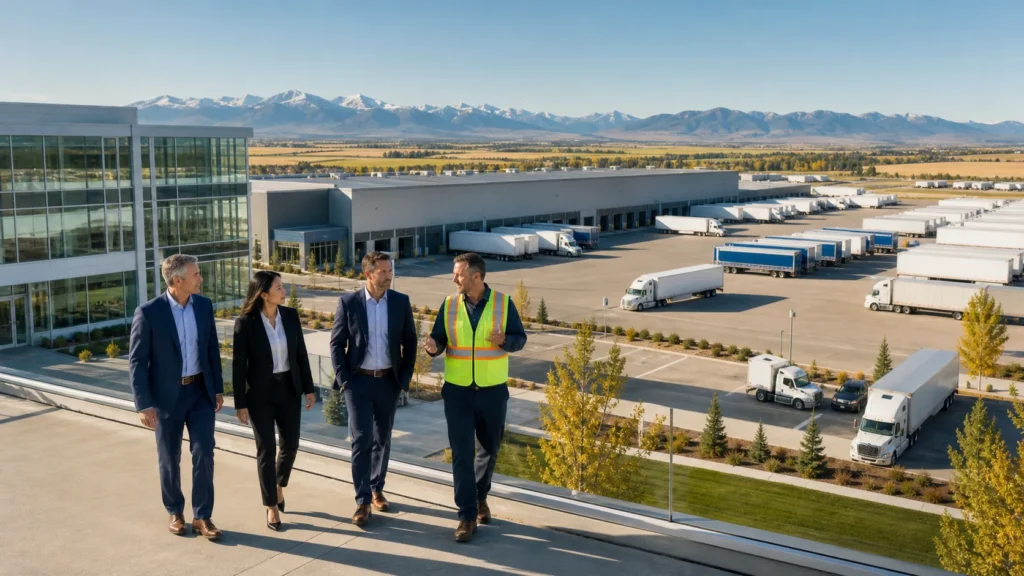
Headline: Where Alberta Commercial Real Estate Investment Meets Logistics Growth
Meta Title: Choosing Rail or Highway Access for Alberta Industry
Meta Title: Alberta Industrial Assets Positioned for Logistics Growth
Meta Description: Explore how commercial real estate investment in Alberta is aligning with industrial land, transport corridors and logistics demand across Western Canada
Commercial real estate investment in Alberta is becoming more closely tied to the movement of goods, equipment and people. For us, industrial land is not simply a parcel on a map. Its long-term value depends on whether it can serve real supply chain needs now and remain useful as transportation networks, user requirements and surrounding development change.
Calgary sits at an important meeting point for major highway routes, rail networks and airport access. Connections to the Queen Elizabeth II Highway, Trans-Canada Highway, Stoney Trail, Calgary International Airport and rail infrastructure shape how industrial occupiers assess a location. When we review opportunities, we look beyond current demand and consider what will make a site durable through future growth.
Logistics Growth Is Repricing Industrial Land
Industrial demand is often driven by practical questions: Can a distributor reach customers efficiently? Can a contractor move equipment without delays? Can a manufacturer receive materials and ship finished goods? Can an energy-service company access the regions it serves?
Those questions have changed the way we view commercial real estate investment in Alberta. Available land alone does not create investment value. A site must also have the access, servicing and planning framework needed to support warehousing, distribution, manufacturing, food-related supply chains, construction operations or specialized industrial uses.
Calgary’s population growth and role as a business centre can support continued demand for places where goods and services move efficiently. Statistics Canada’s 2021 Census recorded 1,481,806 people in the Calgary census metropolitan area, up 5.5 per cent from 2016. Statistics Canada also reported $156.4 billion in Alberta international merchandise exports in 2023. These figures do not establish the value of any individual industrial property, but they illustrate the scale of the population base and trade activity that industrial infrastructure serves. Across Alberta, trade routes, agricultural production, energy activity and construction all create different forms of industrial demand. We avoid treating every industrial area as interchangeable because a highway-oriented site, a rail-adjacent property and an airport-area location may appeal to very different users.
A longer investment view usually includes:
- Transportation access and future road capacity
- Municipal servicing and utility availability
- Labour access and surrounding employment growth
- Land-use policy, zoning and possible future redevelopment
- The range of industrial users a site could support
Publicly available information from municipal growth reports, transportation departments, economic development organizations and commercial market reports can help us test assumptions. The purpose is not to chase a single quarter of leasing activity. It is to understand whether a property can stay relevant when market conditions shift.
Infrastructure Turns Land Into a Supply Chain Asset
A well-located industrial parcel gains much of its value from the systems around it. Highway visibility may be helpful, but proximity alone is not enough. We need to understand how trucks actually enter and leave the property, whether roads can handle heavy traffic, and whether users can operate safely year-round.
For larger facilities, the details become even more important. Distribution centres may need deep truck courts, efficient trailer circulation, loading access and reliable connections to regional routes. Industrial campuses may require staged road construction, significant utility capacity and stormwater systems designed for a full buildout rather than one initial building.
When we assess infrastructure readiness, we consider issues such as:
- Truck turning movements, intersection capacity and site access
- Water, sanitary, power and stormwater servicing
- Rail potential, airport access and intermodal connections
- Off-site road upgrades and related approval requirements
- Timing risks tied to municipal infrastructure plans
Transportation and servicing investments can take years to produce their full effect. A planned ring-road connection, airport-area expansion or industrial road upgrade may improve a location’s appeal over time. On the other hand, delayed servicing or constrained access can materially change the risk of a project that otherwise appears attractive.
That is why we look at infrastructure plans early. The value of industrial land is often established long before a building is complete, through the decisions that make future use possible.
Underwriting Commercial Real Estate Investment in Alberta
Not every industrial investment carries the same risk. A serviced warehouse property with income in place is different from development land awaiting land-use approvals, roads and utilities. Both may be worthwhile opportunities, but each requires a different underwriting approach.
With income-producing assets, we examine the building, tenant profile, lease terms, replacement conditions and the property’s ability to meet future occupier needs. For land holdings, the focus may shift toward zoning, servicing obligations, entitlement timing, environmental conditions and the capital needed before development can begin.
We also ask whether the property offers more than one path forward. A site that can reasonably support several industrial uses may be better positioned than one tied to a narrow tenant category. This does not mean every parcel should be designed for every user. It means the development plan should respect the market depth, site constraints and possible changes in demand.
Calgary’s industrial submarkets can attract distinct groups. Airport-area logistics users may prioritize travel time and cargo access. Southeast industrial properties may appeal to businesses needing highway connections, storage capacity or access to established commercial areas. Rail-adjacent and highway-oriented sites can each have their own operational advantages.
Credible market evidence helps us test these assumptions. We review local land inventories, construction activity, industrial absorption, leasing conditions and broader economic indicators while recognizing that market reports are a point-in-time tool, not a guarantee.
Build Optionality Into Development Decisions
The best industrial site plan is not always the one that fills every square metre immediately. We often find that flexibility matters more over the life of a large landholding. Truck sizes change, tenants adjust their distribution models, and new forms of industrial activity can emerge faster than a long development cycle.
Depending on the location, an opportunity may be better suited to smaller-bay industrial buildings, contractor yards, energy-service facilities, light manufacturing, specialized storage or a larger distribution format. The right choice depends on zoning, infrastructure, parcel size and the pool of likely users.
Phasing can help align roads, utilities and buildings with real absorption. Still, a phased plan must account for the complete project from the beginning. Future access, drainage, utility agreements and servicing requirements cannot be left as an afterthought.
Autumn is a useful time to review these practical details. In Alberta, winter conditions can affect earthworks, servicing schedules and construction sequencing. We use this period to reassess studies, approvals and capital plans before the next construction season.
Match Deal Structure to Asset Complexity
Larger industrial transactions involve more than purchase price and future lease revenue. Title restrictions, easements, environmental history, entitlement status, servicing obligations and development agreements can all affect whether a property is usable and financeable.
Commercial real estate investment in Alberta may involve direct acquisitions, joint ventures, land assemblies, phased development arrangements or strategic land holdings. A fully entitled building may require detailed lease and building review, while a development parcel often requires deeper work on municipal approvals, off-site costs and timing.
We rely on the right specialists for the asset in front of us. Lawyers can review purchase conditions, title matters and agreements. Planners can assess permitted uses and policy direction. Engineers may evaluate drainage, geotechnical conditions, utilities and access. Environmental specialists can help identify possible liabilities, particularly where a site has a prior industrial or commercial history.
Position Capital for the Next Logistics Cycle
Alberta’s industrial opportunity is tied to long-term forces: transportation networks, trade relationships, population growth, industrial land supply and the need for reliable supply chains. Patient capital can benefit when a site is selected with those forces in mind rather than a short-term market signal.
Before committing capital, review each holding or prospective property against transportation access, servicing readiness, entitlement status, adaptability and likely future demand. The most durable industrial investments are often the ones prepared to support the next stage of regional growth, even as the needs of occupiers continue to change.
Position Your Capital for Long-Term Industrial Value
At Highfield Investment Group, we help investors assess opportunities where logistics, land use and infrastructure planning intersect. Our approach to commercial real estate investment in Alberta considers the operational realities behind major industrial and commercial assets, from site readiness to long-term market positioning. For a discussion tailored to your acquisition, development or portfolio objectives, contact us to speak with our team.